Disability transport

Disability transport across Perth

Not everyone who needs accessible transport uses a wheelchair. We carry people who walk short distances, who use a frame or a scooter, who can't read a timetable, and who just need a driver willing to wait. Door to door across the metro, from Butler down to Baldivis, any hour of the day.

  • PTSS purple card at 75%
  • Support workers travel free
  • Wheelchair and walking passengers
Who we carry

Accessible transport is broader than a ramp

About one in five Australians lives with disability. Only a small fraction of them use a wheelchair. The rest are people who tire quickly, who can't manage a kerb, who need instructions repeated, who travel with a guide dog, or whose disability is invisible from the driver's seat.

Our vehicles are wheelchair accessible, so the ramp is there for the passengers who need it. For everyone else what matters is a low step, an unhurried driver, somewhere to stow a frame, and a booking that turns up when it said it would.

  • Manual and powered wheelchair users, and mobility scooters
  • Walking passengers using frames, rollators, crutches or sticks
  • Passengers who are blind or have low vision, and guide dogs
  • Passengers with cognitive disability, autism or acquired brain injury
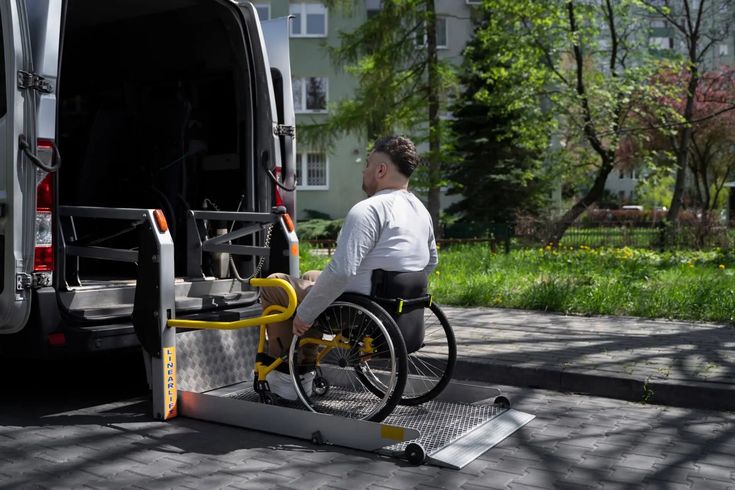
A passenger in a wheelchair boarding an accessible van using the rear powered lift, assisted by the driver.

Tell us once

  • Your equipment and how you board
  • Whether you want conversation or quiet
  • Any help you'd like at either end
What's included

The things that are never an extra

Accessible transport has a long history of charging people for the parts of a trip their disability makes necessary. None of the following costs you anything.

Boarding assistance

Deploying the ramp or hoist, positioning your chair, fitting the four-point restraints and checking them. Never billed as waiting time.

Your support person

Carers, support workers, family and companions travel in the seats beside you at no charge. Nobody follows in a second car.

Door-through-door

Help from the vehicle to a reception desk, a ward, or back inside with the shopping. Ask for it and it's yours at no extra cost.

Guide and assistance dogs

Always welcome, no notice needed, no cleaning fee. It's your legal right and we're not going to make it awkward.

Equipment

What our vehicles will and won't take

Most failed pick-ups in this industry come down to a vehicle arriving that can't take the equipment. Thirty seconds of detail when you book prevents nearly all of them.

Carried as standard

  • Manual folding and rigid-frame wheelchairs
  • Powered wheelchairs, including tilt-in-space
  • Mobility scooters, 3 and 4 wheel
  • Walking frames, rollators and sticks
  • Portable oxygen concentrators and cylinders
  • Guide, hearing and assistance dogs

Tell us when you book

So we send a vehicle with the right clearance

  • Seated height above about 1.4 m
  • Combined chair and occupant weight over 200 kg
  • Chairs you recline or tilt while travelling
  • A hoist sling or transfer board you bring
  • More than one wheelchair on the same trip

What we can't do

Non-emergency transport only

  • Stretcher transport
  • Clinical care or monitoring in transit
  • Personal care, medication or feeding
  • Lifting a passenger out of a wheelchair

If you need care during the journey rather than help getting in and out, that's a patient transport service. In an emergency, call 000.

PTSS, read this bit

The subsidy rule almost nobody explains properly

If you hold a PTSS card, the vehicle you book changes how much of your fare is subsidised. This one rule is worth more to most passengers than any discount a taxi company could offer, and it is routinely misstated on Perth transport websites. Several are still advertising TUSS vouchers that stopped working in October 2025.

The purple card pays 75%, but only in a wheelchair accessible taxi

The Passenger Transport Subsidy Scheme replaced the Taxi User Subsidy Scheme on 1 March 2025. Under it, a wheelchair-subsidy participant holding a purple PTSS card receives 75% of the fare, up to a maximum subsidy of $35, when they travel in their wheelchair in a wheelchair accessible taxi.

Put that same passenger in a conventional taxi and the rate drops to 50% of the fare, capped at $25. Same card, same trip, a materially different bill, purely because of which vehicle turned up. If you hold a purple card, booking an accessible vehicle isn't a preference. It's the difference between two subsidy rates.
The yellow card is the standard 50% subsidy

Participants who qualify for the standard subsidy hold a yellow PTSS card and receive 50% of the fare, capped at a $25 subsidy per journey, in any on-demand rank or hail vehicle. There's no vehicle-type uplift on the yellow card, so choose whatever suits you on the day.

Paper vouchers are gone. The card is a smartcard now

The old green TUSS vouchers stopped being accepted on 1 October 2025. PTSS runs on a smartcard the driver taps at the start of the journey and again at the end, which works the subsidy out against the metered fare automatically. Green TUSS cardholders were reissued purple PTSS cards carrying their previous entitlement.

A few practical rules catch people out. You or your carer must keep hold of the card during the trip, and you must never leave it with a driver. It can't be lent, sold or given to anyone else. A family member can't be the driver on a subsidised journey. The subsidy doesn't apply to tips.

PTSS eligibility, subsidy rates and caps are set by the WA Department of Transport and Major Infrastructure and can change. Figures above were checked in August 2026. Confirm your own entitlement on 13 11 56 or at transport.wa.gov.au.

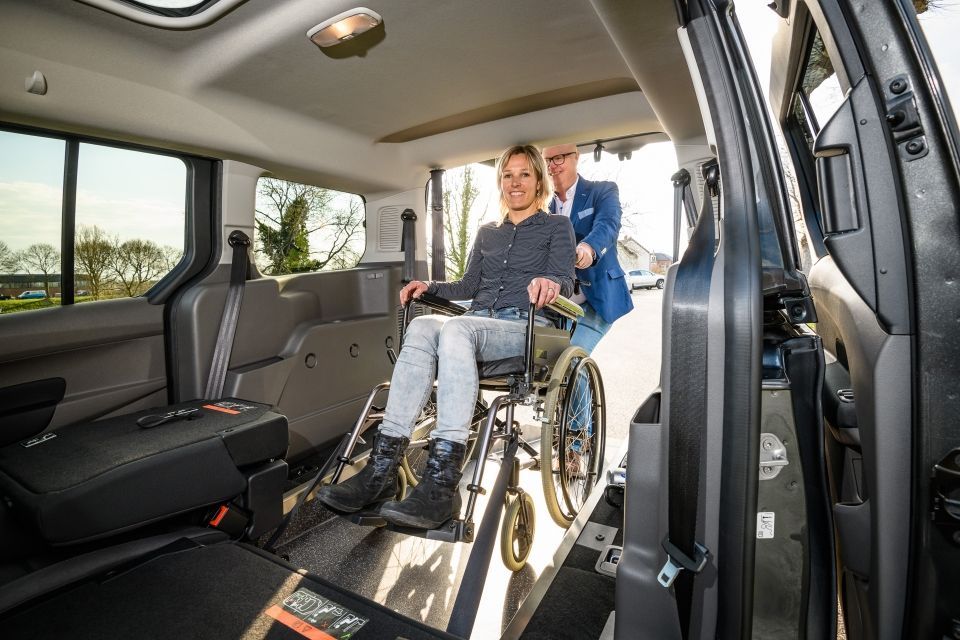
A support worker assisting a woman in a wheelchair inside the spacious interior of an accessible van.

One record per passenger

Chair type, boarding preference, whether they like the radio on, which arm not to take. Written down once so nobody has to explain it again at 7am on a Tuesday.

For providers and coordinators

Booking on behalf of someone else

A good share of these trips get arranged by somebody other than the passenger. A support coordinator, a plan manager, an aged-care provider, a hospital social worker, or an adult child living in Melbourne trying to sort something out from three thousand kilometres away. We're set up for all of it.

You can hold an account, book for several clients, nominate who receives confirmations, and have invoices issued to the organisation rather than settled trip by trip in the vehicle. What we need from you is the passenger's equipment, any communication preferences, and a number to call if the day goes sideways.

  • Organisation accounts with consolidated monthly invoicing
  • Bookings for several clients under one contact
  • Confirmations sent to the coordinator as well as the passenger
  • Notes kept on equipment, routines and communication needs
What it costs

Fares, PTSS and NDIS funding

Metro trips run on the WA Government maximum metered rates with no accessibility surcharge, and pre-booked journeys can be quoted as a fixed price. A purple PTSS card pays 75% of the fare, up to a $35 subsidy, when you travel in your wheelchair in a wheelchair accessible taxi.

Good to know

Disability transport questions

However you travel

Book accessible transport in Perth

Tell us your equipment, your destination and when you need to be there. We'll match the right vehicle and apply any subsidy you're entitled to.

Call nowBook online