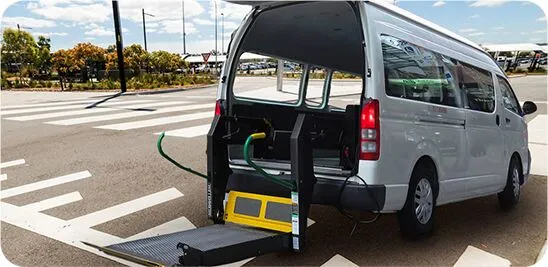
Most Perth taxi sites won't put a number on this page. Here are the WA Government maximum metered rates in full, what a maxi costs on Tariff 3, and the PTSS rule that decides how much of the fare you actually pay.
Perth taxi fares are capped by the WA Department of Transport, so these are maximums rather than our invention. Which tariff applies depends on the time of day and how many people are travelling.
Western Australian maximum metropolitan taxi fares by tariff
Tariff
When it applies
Flagfall
Per km
Waiting
Tariff 1
Mon–Fri, 6am–6pm
$5.60
$2.20
$63.00/hr
Tariff 2
Nights, weekends & public holidays
$8.00
$2.20
$63.00/hr
Tariff 3
5+ passengers or a large vehicle
$8.00
$3.29
$98.00/hr
Additional charges and surcharges
Charge
Amount
When
Call-out fee
$2.00
Where a guaranteed booking fee doesn't apply
Ultra peak
$4.70
Midnight–3am, Saturday and Sunday mornings
Christmas Day
$6.60
Surcharge applied once per trip
New Year's Eve
$7.70
Surcharge applied once per trip
Accessibility
$0.00
There is no accessibility surcharge. Ever.
Maximum metered fares are set by the WA Department of Transport and reviewed annually against the Perth Private Motoring CPI sub-group. Figures checked August 2026. Confirm current rates at transport.wa.gov.au, or just ask us for an estimate.
A worked example
What a 10 km trip actually comes to
Ten kilometres is roughly Victoria Park to Fiona Stanley Hospital, or the CBD out to Bayswater. Here is the same trip four ways, on a weekday daytime meter and before any waiting time.
The metered fare: about $27.60
Tariff 1 flagfall of $5.60, plus 10 km at $2.20, comes to $27.60. On Tariff 2, meaning after 6pm, at a weekend or on a public holiday, the higher $8.00 flagfall takes the same trip to $30.00. In a maxi on Tariff 3 it's $8.00 plus 10 km at $3.29, or $40.90.
With a purple PTSS card, in an accessible taxi: about $6.90
The wheelchair subsidy pays 75% of the fare when you travel in your wheelchair in a wheelchair accessible taxi. On $27.60 that's a $20.70 subsidy, comfortably inside the $35 cap, leaving you $6.90 to pay.
With the same card, in a conventional taxi: about $13.80
Put the identical passenger on the identical route in a normal car and the rate drops to 50%, capped at $25. The subsidy is $13.80 and you pay $13.80. Twice as much, purely because of the vehicle that turned up. This is the single most valuable thing to know about PTSS, and almost nobody explains it.
Where the $35 cap starts to bite
The 75% rate applies in full until the subsidy would exceed $35, which happens at a fare of about $46.70. Beyond that you pay the excess, so on a $60 fare the subsidy is $35 and your share is $25. For long trips it's worth asking us for a fixed quote rather than running the meter.
Illustrative only, using published maximum rates and excluding waiting time, tolls and surcharges. Your actual fare depends on the route, the traffic and the time of day.
PTSS
Which card do you hold?
The Passenger Transport Subsidy Scheme replaced TUSS on 1 March 2025. It runs on a smartcard the driver taps at each end of the journey, and the colour of that card decides your rate.
Purple card
Wheelchair subsidy
75% of the fare, up to a $35 subsidy, when you travel in your wheelchair in a wheelchair accessible taxi. In a conventional taxi the same card pays 50%, capped at $25, so the vehicle you book genuinely matters.
Yellow card
Standard subsidy
50% of the fare, up to a $25 subsidy, in any on-demand rank or hail vehicle. There's no vehicle-type uplift, so book whatever suits your needs on the day.
Green TUSS card
No longer valid
Paper TUSS vouchers stopped working on 1 October 2025. Green cardholders were reissued purple PTSS cards with the same entitlement. Never received yours? Call the Department of Transport on 13 11 56.
Four rules that catch people out
You or your carer must keep hold of the card during the journey, and never leave it with a driver. The card can't be lent, sold or given to anyone else. A family member can't be the driver on a subsidised trip. And the subsidy doesn't apply to tips.
PTSS eligibility, rates and caps are set by the WA Department of Transport and Major Infrastructure. Checked August 2026. Confirm your own entitlement on 13 11 56. Nothing on this page is funding advice.
Other funding routes
Beyond the taxi subsidy
PTSS isn't the only way to reduce what a trip costs you. Depending on your circumstances, one of these may apply instead, or as well.
NDIS transport funding
Where transport is funded in your plan, plan-managed participants can have us invoice their plan manager directly and self-managed participants receive claim-ready receipts. See how NDIS transport works.
Support at Home
Support at Home replaced Home Care Packages on 1 November 2025 and transport is a fundable service under it, subject to means-tested co-contributions. See aged-care transport.
PATS for country patients
Country WA residents travelling over 100 km to the nearest specialist may be subsidised under the Patient Assisted Travel Scheme. See regional transport.
Quoted before you commit
For anything pre-booked we'll put a number on it in advance, so the decision is made on a figure, not a guess.
The same as any other taxi trip of the same distance, because there is no accessibility surcharge. Under the WA Government maximum rates, a weekday daytime trip runs on Tariff 1 at a $5.60 flagfall plus $2.20 per kilometre, so a 10 km trip comes to about $27.60 before any waiting time. Nights, weekends and public holidays run on Tariff 2 with an $8.00 flagfall. Rates are current as at August 2026 and reviewed annually.
Maxi work runs on Tariff 3, which applies when five or more passengers travel or a large vehicle is requested: an $8.00 flagfall and $3.29 per kilometre, with waiting time at $98.00 per hour. That's roughly 50% more per kilometre than a standard car, but it replaces two separate taxis with two flagfalls, so for a group it is almost always the cheaper answer.
It depends on your card and the vehicle. The purple wheelchair-subsidy card pays 75% of the fare up to a maximum subsidy of $35 when you travel in your wheelchair in a wheelchair accessible taxi, but only 50% up to $25 in a conventional taxi. The yellow standard-subsidy card pays 50% up to $25 in any taxi. On a $27.60 trip, a purple cardholder in an accessible taxi pays about $6.90, against $13.80 in a conventional one.
No. The Passenger Transport Subsidy Scheme replaced the Taxi User Subsidy Scheme on 1 March 2025, and paper TUSS vouchers stopped being accepted on 1 October 2025. PTSS runs on a smartcard the driver taps at the start and end of the journey. Green TUSS cardholders were reissued purple PTSS cards keeping their previous entitlement. If you never received one, call the Department of Transport on 13 11 56.
No. Charging a passenger more because they use a wheelchair is something we won't do. Ramps, hoists, restraints, help boarding and door-through-door assistance are all part of the service at no additional cost, and the minutes spent deploying a ramp and securing a chair are not billed as waiting time. Carers and companions travel with you free of charge.
Where transport is funded in your plan, yes. If you are plan-managed we invoice your plan manager directly. If you are self-managed you pay for the trip and we provide an itemised receipt so it can be claimed. If you're agency-managed, call us first. The transport allowance is usually paid to participants directly rather than to a provider, so we'll work out the cleanest arrangement before you book.
Yes, for pre-booked trips. Airport transfers, group and event bookings, and every long-distance or regional journey are quoted as a fixed price up front covering the distance, the return leg and any agreed waiting. Regular weekly journeys such as dialysis, therapy or a day program can be set up as a standing booking at the same agreed rate each time.
Cash, EFTPOS and major credit cards in the vehicle, PTSS smartcards, and invoicing to NDIS plan managers, Support at Home providers and disability service organisations with an account. Tell us how you'd like to pay when you book so it's sorted before the trip rather than at the kerb.
No surprises
Ask us what your trip will cost
Tell us where you're going and which card you hold, and we'll give you a straight answer before you book anything.